Events 2 min read
Kwantis Co-Authors Paper on Blowout Risk Reduction Presented at IADC Drilling Africa 2026
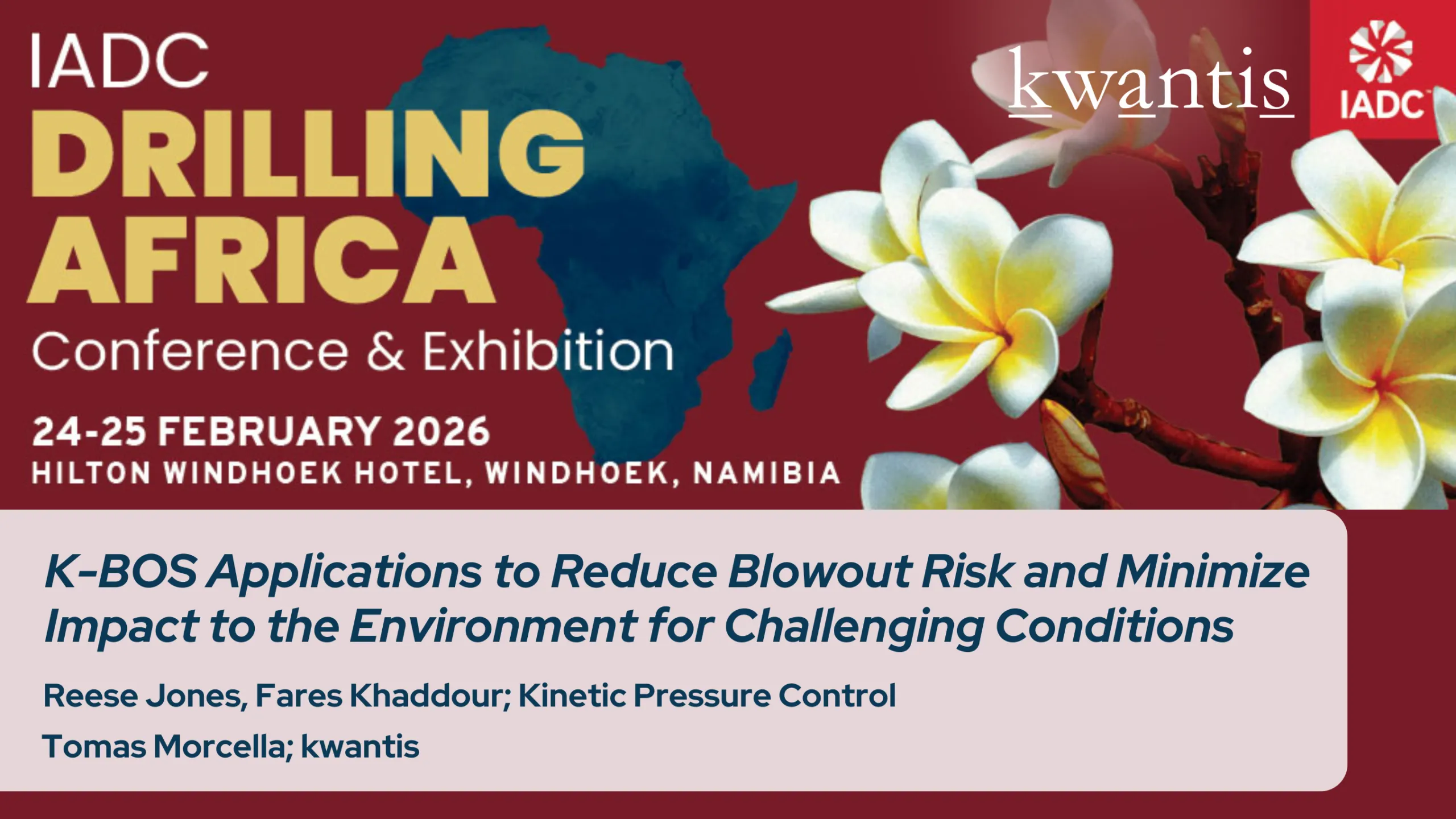
Kwantis co-authored a technical paper presented at the International Association of Drilling Contractors (IADC) Drilling Africa Conference & Exhibition, held on 24–25 February 2026 in Windhoek, Namibia.
The paper, titled “K-BOS Applications to Reduce Blowout Risk and Minimize Impact to the Environment for Challenging Conditions,” was developed in collaboration with Kinetic Pressure Control and highlights a step-change technology aimed at strengthening well control and emergency response capabilities across Africa’s diverse operating environments.
Addressing Africa’s Well Control Challenges
Wells across Africa frequently present unique operational challenges, including environmentally sensitive locations, high-rate oil production, non-vertical well access, and extended logistics timelines for mobilizing source control equipment. These conditions increase the complexity of blowout prevention and mitigation.
The paper examines how the Kinetic Pressure Control Blowout Stopper (K-BOS) technology can significantly reduce both the likelihood and potential impact of blowouts under such demanding conditions.
K-BOS: Rapid Shear and Seal Capability
K-BOS is a pyro-mechanical ram technology designed to shear and seal any tubular in less than one second, under virtually any well condition. The system is pyrotechnically actuated, providing shear and seal certainty in milliseconds.
For floating rigs, K-BOS can be retrofitted into an existing subsea blowout preventer (BOP) or installed as an independent shut-in device (ESID). In surface BOP applications, it can be integrated into the BOP stack or installed directly on top of the wellhead. This flexibility enables operators to enhance well control barriers without fundamentally redesigning existing systems.
Quantifying Environmental Risk Reduction
A probabilistic risk analysis (PRA) presented in the paper quantifies the potential benefits of K-BOS deployment in subsea wells. By combining blowout probability with modeled event duration, the analysis estimates an ALARP-risked hydrocarbon release volume.
This approach allows emergency response planning to be based on predicted quantitative outcomes rather than worst-case scenarios. By minimizing hydrocarbon release, the technology significantly reduces environmental impact.
A Step Change in Well Control
The authors conclude that K-BOS represents a major advancement in well control and emergency response strategy. In regions with constrained infrastructure, the system provides a cost-effective and reliable alternative to conventional source control measures.
Kwantis’ collaboration on this paper reflects its continued commitment to advancing innovative, risk-based solutions that enhance operational safety while minimizing environmental impact in challenging offshore and onshore environments.