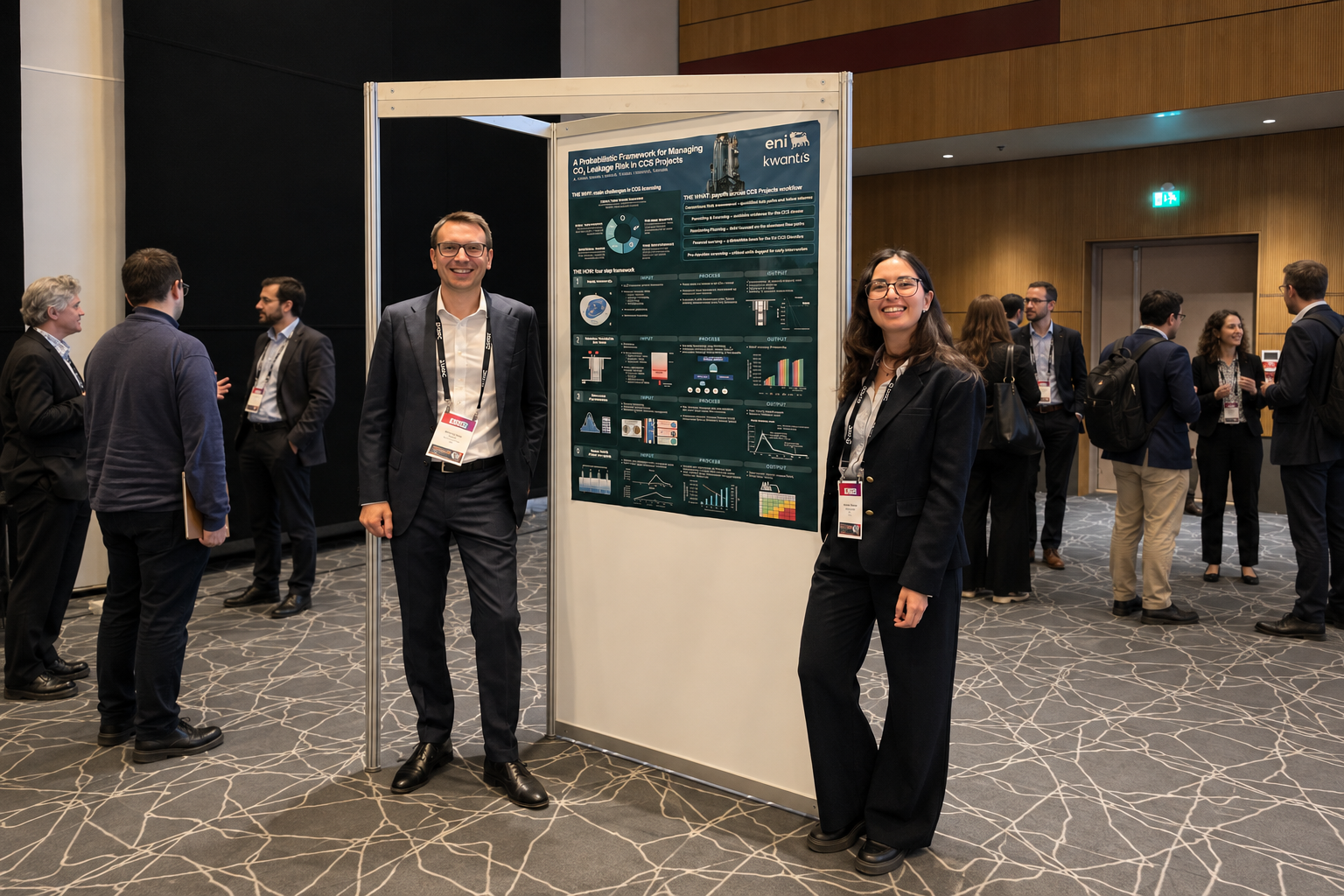
Kwantis co-authored “A Probabilistic Framework for Managing CO₂ Well Leakage Risk in CCS Operations,” presented at the IADC International Well Control 2026 Conference & Exhibition, held on 13–14 October in Stavanger, Norway. Developed in collaboration with Eni, the study introduces a quantitative approach to assessing and managing well leakage risk in Carbon Capture and Storage (CCS) projects.
Understanding Legacy Well Leakage Risk
Ensuring long-term CO₂ containment requires an understanding of how legacy wells respond to changing reservoir conditions. As injection progresses, increasing pressure and an expanding pressure plume can interact with pre-existing wells, creating potential pathways for fluid migration. Assessing how these risks evolve is essential for effective monitoring and mitigation.
An Integrated Probabilistic Framework
The methodology combines well barrier reliability modelling with analytical leakage calculations within a single probabilistic framework. Fault-tree analysis identifies potential leakage paths through tubulars, annular cement and cement plugs, accounting for material degradation over time. Monte Carlo simulation then combines barrier failure probabilities, leakage rates and leak duration, including the operations required to stop a release.
Quantifying Risk to Guide Mitigation
The resulting estimates quantify the likelihood and potential magnitude of leakage over time, highlighting critical barriers and periods when risk may increase. These insights help operators prioritise well interventions, define mitigation measures and prepare corrective actions.
Supporting Decisions Throughout the Storage Lifecycle
Beyond technical risk assessment, the framework can support storage permit applications and the development of risk-based Measurement, Monitoring and Verification (MMV) plans. Its outputs also provide a quantitative basis for estimating monitoring, remediation and post-closure costs, helping operators allocate resources throughout the storage project lifecycle.
This contribution builds on Kwantis’ expertise in well integrity and probabilistic risk analysis, supporting informed decisions for the safe, long-term containment of CO₂.